
5 Insights to Boost Your Language Learning

I have been studying foreign languages since I was nine—44 years on a roller coaster of ups and downs, successes and failures, thrills and challenges.
I started learning French when I was in the fourth grade when high school students came to our elementary school to teach us the basics of the language: colors, numbers, letters, animals.
I fell in love with the French language and became determined to master it, teach it, and live in France one day.
I did.
I rode the exhilarating language-learning roller coaster through middle school, high school, university, study abroad, life abroad . . .
As hard as we try, no classroom language learning experience can ever replace full integration in a country, culture, and language. When you are thrown in and have to sink or swim, you learn to speak the language—fast.
I learned Arabic in Morocco. My language study consisted of in-person classes five days a week, weekly conversations with market vendors, and non-stop "Mint Tea Talk" visits with local friends and neighbors.
I still love Arabic and use it regularly in my work.
Spanish came later. By then I was 47, and let's just say my brain didn't absorb vocabulary quite as effortlessly as it did when I was nineteen!
Despite the challenges, I was highly motivated to learn Spanish and got off to a great start in 2019.
Then, WHAM!
COVID-19 hit the world, and it hit Spain hard.
We continued our language learning online, but we were in survival mode—the whole world was. We were trying to manage a global pandemic, help our kids adapt to online school, stay healthy, and stay sane.
Needless to say, becoming fluent in Spanish was not our number one priority and not at the top of our to-do list.
My Story, Your Story
That's my story.
You probably have yours, too.
Many of us have personally experienced the ups and downs of language study.
How can we learn a foreign language well while also managing all the other challenges of settling into a new country? We have to set up a new home, help our family survive culture shock, learn how to cook without familiar ingredients, make new friends, understand the culture, help our kids adjust to new schools, and somehow still find time to enjoy the adventure.
How can we successfully add language learning to the mix?
I've discovered that the answer isn't perfection. It's consistency.
1. Stop trying to sound perfect.
I can remember my first year living in France. I tried hard to lose my American accent, before realizing that my accent was with me to stay. I would never sound French, no matter how fluent I became in the language.
One of the biggest obstacles to language learning isn't poor grammar or strong accents—it's fear.
We worry about making mistakes, using the wrong verb tense, or accidentally saying something embarrassing. The truth? Most people appreciate the effort. They aren't grading your accent or mentally correcting every sentence. They're usually cheering you on.
In Morocco, store merchants and neighbors would often chuckle when I spoke Arabic. I would ask, “Are you laughing at me or with me?” They always responded that they were not laughing at me. “Well, I’m glad I made you happy today!” I would say, as I walked off.
Some of my funniest memories abroad started with language mistakes. I've accidentally asked for things that didn't exist, mixed up words with completely different meanings, said something vulgar, and left conversations wondering what on earth I had just agreed to. We laugh, we learn, and somehow those mistakes stick in our memories far better than vocabulary lists.
Mistakes aren't evidence that we're failing. They're proof that we're communicating.
2. Learn the language of your everyday life.
Forget memorizing fifty words you'll never use.
Instead, learn the vocabulary you need today.
If you're taking your children to school, learn school vocabulary. If you love cooking, learn food words and recipe measurements. If you visit the pharmacy regularly, learn health-related expressions.
Language becomes memorable when it's immediately useful.
If you hear a new vocabulary word, try to use it multiple times that same day to help it stick.
Think about your daily routine and build your vocabulary around the life you're actually living, not the life your textbook creates.
3. Create tiny daily habits.
You don't need two-hour study sessions.
Fifteen focused minutes every day often beats three hours once a month.
Listen to a podcast while walking.
Read a children's book before bed.
Review vocabulary while waiting in the grocery store check-out line.
Change your phone settings into your new language.
Small habits add up over time. The goal isn't to study harder; it's to make language a natural part of everyday life.
4. Find people, not just resources.
Apps are wonderful. Classes are valuable. But people are unforgettable.
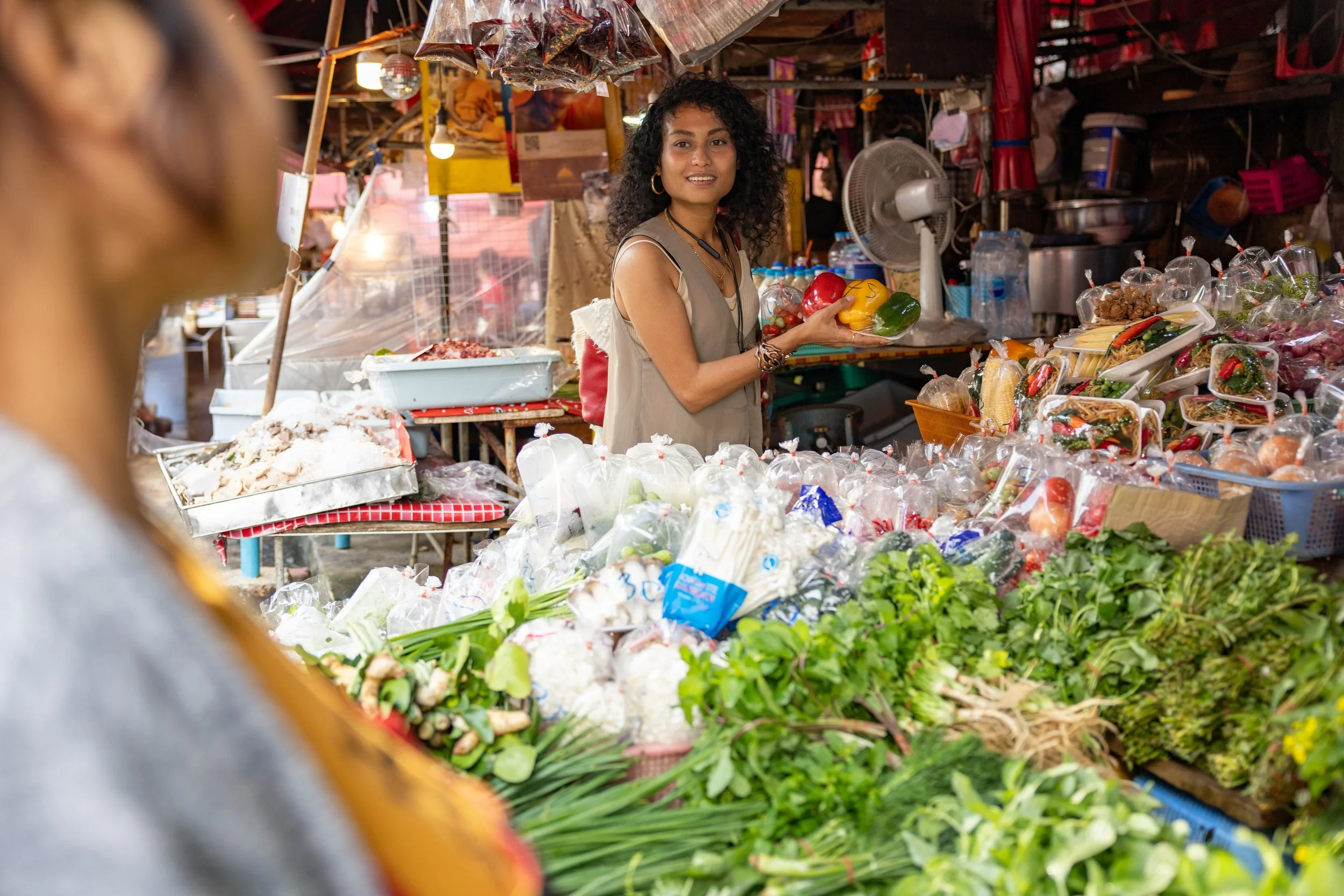
Some of my greatest language teachers never stood in front of a classroom. They sold vegetables at the market. They invited me into their homes for mint tea. They patiently listened while I searched for words. They laughed with me instead of at me.
Language is about relationships.
The more you build genuine friendships, the more opportunities you'll have to practice naturally. Before you know it, you’ll be learning without even realizing it!
5. Celebrate progress instead of chasing fluency.
Expats often set impossible standards.
"I'll be happy when I'm fluent."
But fluency isn't a finish line. It's a moving target.
Celebrate ordering a meal without switching to English.
Celebrate understanding a joke.
Celebrate making a phone call.
Celebrate surviving your first appointment at the doctor’s office without a translator!
Those small victories are actually huge milestones. Looking back, you'll realize they quietly added up to something remarkable.
Reward yourself with a favorite treat or activity to mark the win.
Keep Riding
Forty-four years after my first French lesson, I'm still learning.
Some days I feel like I can navigate almost any conversation. Other days I draw a blank on a word I've known for years (in my own native language!). There are moments when I leave a conversation feeling proud, and others when I replay every sentence in my head, kicking myself and wishing I'd said something differently.
That's language learning.
It's a roller coaster.
There are exciting climbs when the dots seem to connect and everything clicks, unexpected drops that leave you wondering if you've made any progress at all, and breathtaking moments when you suddenly realize you're no longer translating every sentence in your head—you've simply started to live and dream in another language.
If you're an expat, remember this: learning the language isn't just about speaking correctly. It's about saying yes to deeper friendships, understanding the culture beyond the surface, laughing at jokes, helping your neighbor, comforting a friend, and slowly building a life that feels less foreign and more like home.
So don't wait until you're "fluent" in the host language to start living your new adventure.
Say yes to conversations. Ask questions. Make mistakes. Laugh at yourself. Celebrate every little victory.
Most of all, give yourself grace.
Because one day you'll look back and realize that all those ups and downs—the awkward conversations, the embarrassing mistakes, the small breakthroughs, and the unexpected triumphs—weren't interruptions to your journey abroad.
They were the journey.
And that's an adventure ride worth taking.
Want a little encouragement?
If you've ever mixed up words, accidentally insulted someone, or completely misunderstood a conversation in another language, you're in good company! I've collected many of my funniest language-learning adventures in Language Learning Laughs—because sometimes the best way to become more confident is simply to learn to laugh along the way.
Guest author, Marci Renée, is a global nomad who has traveled to more than 30 countries and has lived in the United States, France, Morocco, and Spain. She loves to travel, speak foreign languages, experience different cultures, eat ethnic foods, meet people from faraway lands, and of course, write and tell stories. She is a published author of children's picture books, memoirs, short stories, and poetry.
You can find Marci and her books on her website.
"The Cultural Story-Weaver," at www.culturalstoryweaver.com